Posts

12d Model 14 Highlights

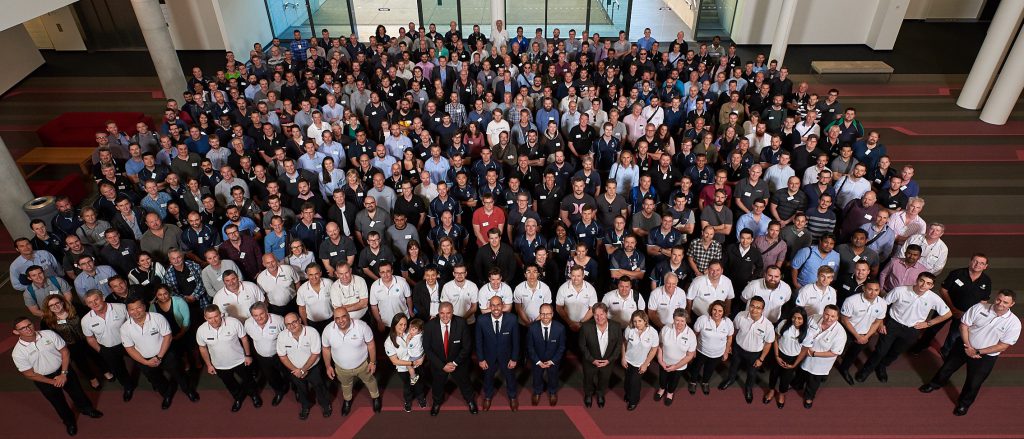
Group Photo 2018 12d Technical Forum
Group Photo – 2018 12d Technical Forum

12d Model 14…as presented at the 12d Technical Forum 2018!

When 12d Solutions Managing Director Dr Lee Gregory set out to write his opening speech for the 2018 Technical Forum, he decided it was time to make something clear…that we can confidently now call 12d Model the world leading Civil BIM solution! In fact, all the different types of data sets in 12d Model that have already been there for full 3D existed long before people started talking about the word ‘BIM’.

All the different attributes we had – String, Vertex, Segment, Model, Project – how many other packages have vertex and segment attributes as well as string attributes?

We actually showed reading and writing IFC data at our events here in 2010 and even earlier…at the time, many people said ‘why would we want to do that’? Now everyone is talking about BIM.

We’ve always been on the cutting edge of what’s needed…because we listen. Another good example is 12d Field – surveyors using 12d Model on tablets out in the field. Everyone is starting to do that now…15 years later.

We want to continue ‘pushing the boundaries’ (as per the 2018 Technical Forum theme) – that’s why we keep asking for user feedback.

Lee then proceeded to explain the 12d Model Release Cycle. In brief, the full release starts with a version C1a (‘C’ means ‘release version’). Then over the next two years, we release subversions C1b, C1c, etc.

Some developments within a sub version are bug fixes and the like, but we also add new options. So we don’t just stop when we first release a version; we keep working on that version for the next two years…e.g. ARR 2016 etc. went into 12d Model 12…also 12d View.

So we never stop – there is continual development over the lifetime of a 12d Model version.

For example, 12d Model 12 C1a was released in October after the 12d Conference 2016…and that was the time we began work on 12d Model 14. But work still progressed on 12d Model 12 C1b, C1c, etc.

12d View is a free 12d Model viewer. It can use existing 12d Model 12 nodes file and dongles. Users on Maintenance simply register to have access to this handy functionality.

The 12d Technical Forum 2018 is now over, and what a success it was – over 530 attendees!  From this very event, users on Maintenance will gain access to the ‘Technical Preview’ version of 12d Model 14. This is the final Beta version – we’d love for you to give us your feedback before we finally release 12d Model 14 in October. If you notice things that are missing or could be done better, feel free to let us know. Once we release, we can’t put anything new into the database, so we like to get everything as complete as possible before then.

Then we’ll start working on 12d Model 15…but we’ll continue adding things to 12d Model 14 until the 2020 Technical Forum.

As previously mentioned, there is no 12d Model 13. We once released a version on Friday 13th and it was a disaster. We’re not generally superstitious, but it seemed sensible not to ‘tempt fate’, as it were!

These features of 12d Model 14 were covered in the ‘What’s Coming’ Webinar earlier this year:

  • Model tree
  • Project settings
  • Civil BIM and IFCs
  • Combined 12d Field
  • GDA2020
  • ARR 2016
  • Point clouds
  • Multipage Plots
  • MTF on steroids
  • Attribute Manipulator
  • Setting out BIM
  • 12d View

This is what’s happened since that webinar…

We’ve rearranged the Main Menu – e.g. added BIM menu, Volumes menu, and Water menu; relocated Edit, Drafting, and Window.

We’ve added loads of new features for Water – e.g. the ‘Drainage-Sewer string’ has been replaced by a ‘Water string’, references to ‘pit/manhole/maintenance hole’ now refer to ‘nodes’, references to ‘pipe’ now refer to ‘link’ (this is all better terminology).

You can now display Node HGL and Link HGL in 3D…we’ve added extended nodes and risers for nodes in the Water string, added a Setout diagram for Nodes as well as User defined house connections…and more settings; the list goes on!

Brief notes on ARR 2016, or Australian Rainfall and Runoff 2016 (actually available in 12d Model 12 if you’re on Maintenance):

  • Events are expressed as Average Exceedance Probability (AEP in %), not Average Recurrence Interval (ARI in years). AEP is approximately the inverse of ARI
  • For each duration (10min up to 7 days), there are 10 events
  • Each event is run and the trimmed mean of the 10 storms is calculated (this is the mean excluding outliers e. 2 standard deviations from the mean). The event closest to the trimmed mean is then used as the critical duration
  • The critical storm is the worst case of all the critical duration events
    This is done for every attribute result (catchment flows, pipe flows, pipe velocities, HGLs, volumes…)
  • Is not Rational method – Dynamic instead. You need the Dynamic Drainage module to use it
    10x as long to run but works to standard so necessary
  • GPU usage for TUFLOW calculations.

Trimeshes were introduced in 12d Model 11 as a generalisation of TINs to represent objects that fold back over themselves. Trimesh usage was expanded in 12d Model 12, and they are now a fundamental part of 12d Model. Trimeshes appeared in many places during the Technical Forum – in User talks, Birds of a Feather sessions, with BIM, Snippets, MTFs, etc.

New trimesh-related features include Face Snap, which allows users to snap on to the face of a trimesh. This, of course, meant a new abbreviation for Fast Snap needed to be found, so it has been renamed to ‘Quick snap’. You can turn off Face snap, and if you’ve got Point snap on it will grab the vertices of a trimesh; if you’ve got Line snap on it will grab the edge.

Other new trimesh-related features include: Creating traffic lights as trimeshes, creating trimeshes from Tunnel Boring Machine (TMB) rings, creating trimeshes for pits, along a string, etc. We’ve also added functionality surrounding MTF for tunnels – inner and outer tunnel walls can be formed as one trimesh, and all the strings can be independently controlled in the MTF.

In fact, there’s so much in the way of examples of further new trimesh-related features that I’m just going to revert to bullet points again now…

  • Invisible faces so closed for volumes for the inside of the tunnel
  • Bridges created as trimeshes
  • Data source on flip trimesh faces
  • Create normals to trimesh faces
  • Boolean operations – union, intersection, subtraction
  • Cookie cut by polygon
  • Toggle for applying texture mapping in perspective view
  • Toggle Trimesh wireframe – toggle on/off in an OpenGL view
  • Drawing density for perspective views – global, view, none
  • Shade is now turned on by default for a new Perspective View
  • Joystick – can now go over the top instead of stopping when almost vertical
  • Move over TIN
  • Trimesh Editor – add a vertex, delete an edge, pull a whole face out, etc.
    12d Trimesh edges can have colours and names – this is very important for setting out
  • Set trimesh edge info by strings.

We’ve also added a new Settings option for saving various settings for an existing project (Project => Settings) – this replaces a number of files and defaults previously used. There are Named profiles of settings, and a different profile can be selected at any time in a session. Profiles can be duplicated, renamed, deleted, and all saved to a file, and a file of new Profiles can be loaded at any time in a session. You can now turn Super Inquire on/off, and save the Super Inquire style used. Another handy new feature is Autosave screen layout – when this is ticked on and a project is saved, the position and information for most menus and panels on the screen is also saved. The menus and panels will be restored when the project is reopened. We’ve even added the settings for Add/Remove models for Views to Settings, and now have different settings for Search Bar.

In the realm of File I/O, we’ve combined 12da and 12dXML in Reader and Writer, and the ability to write Hexadecimal floating point format to 12da and 12dXML (this is an international IEEE Standard for reading and writing floating point numbers without loss of precision). Real numbers look different but all the other text in the file is readable as normal. You can now tick on panels with anonymous functions, to create (or not create) one, and there are also options to read in KML files, and VISSIM files.

We’ve made additions to the Attribute Manipulator and renamed the menus so you know if a command applies to super strings, TINs, and/or trimeshes. The additions include X, Y, and Z co-ordinates; Element create and modified dates; and linestyles for Segments.

GDA 2020–MGA 2020…stay tuned for a separate piece on this important development!

Plotting in 12d Model has not escaped an overhaul:

  • Extra Title Block Variables for PPFs
  • Multiple time formats
  • New Perspective Plot PPF – image of what is on a Perspective View and/or a 3D PDF
  • New Section plot PPF (plots the Section View)
  • New Node Diagram Plot PPF – plot an existing Water Network model
  • Multipage Plots – MPS – total rewrite.

In 12d Field, we’ve combined Setout and Pickup…more information to come in future blogs on this!

Now, back to that great ‘buzzword’, BIM – Industry Foundation Classes (IFC)…we’re learning more about this every day. Again, though, it’s important to realise that our users have already been ‘doing BIM’ for years. Data in 12d Model has always been in 3D. ADAC for IPWEA – that’s a BIM system…trimeshes all go out to BIM…the list goes on.

IFC is the international standard for BIM; we supported writing to these already, and in 12d Model 14, we’ve added the ability to read IFCs including User Defined Property Sets for attributes. IFC GlobalUID (GUID) can be created and written out, and maintained when read in. For civil works, alignments and TINs are currently being added to the new IFC Standard IFC 4.1, and they are already supported in the IFC Writer.

Another new feature in 12d Model 14 that’s creating quite a stir is Model Tree – a tree name for models, TINs and functions, instead of just having a flat model name. Trees can be viewed as the tree or in a flat form.

We’ve also upgraded our Documentation and added more to the Help menu, which now includes the Reference Manual, Programming Language Manual PDF, What’s New PDF, What’s New Summary HTML, Getting Started for Design, and Getting Started for Surveying manuals.

With our new User Defined Main Menu, you can make up your own main menu up the top, and also define all the sub menus…complete with a button to take you back to the full 12d Model 14 menu if needed (this will be known as the “Sanity button” if you’re talking to Support!).

We could go on…there are over 300 new things in 12d Model 14…but for now, suffice it to say it’s going to be an exciting release and we can’t wait to share it with all of our customers on Maintenance!

Watch the full video here!

Click here to view an excerpt from this presentation from the 2018 12d Technical Forum:
12d Synergy 4 Highlights

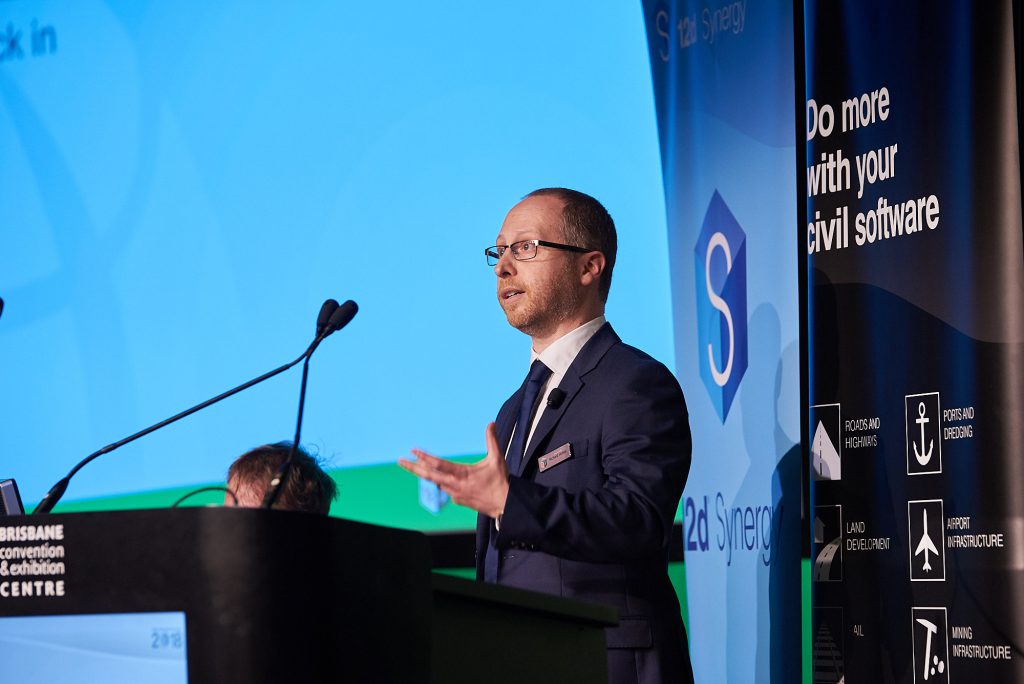
Richard Stoliar – Technical Lead for 12d Synergy – recently spoke to our excited 12d Technical Forum 2018 delegates about the upcoming release of 12d Synergy 4.

Richard Stoliar - Technical Lead, 12d Synergy
Richard Stoliar – Technical Lead, 12d Synergy

Since the release of Version 1.0 in February 2011, a lot has changed in 12d Synergy…we’ve learnt a lot, and responded to feedback, and this new release is going to be a big one. We’ve included over 600 changes, based on user feedback through the Support Portal!

Since 2016, the 12d Synergy user base has grown over 300%…leading to several new staff members required at 12d in various offices.

The main foci for 12d Synergy 4 are:

Speed

As new customers have come on board, we’ve learned a great deal about the different ways in which they structure and access their data – everybody does it just that little bit differently, and we’ve spent a long time analysing that. We’ve worked on making things generally faster as users navigate through the job tree. We’ve looked at faster retrieval of job information and significant optimisation of how we store and analyse files – both these areas have shown marked improvement in Beta Testing. This all leads to less load on infrastructure.

Usability

We had a lot of feedback suggesting that 12d Synergy 3 does a lot of what people need it to do with their files in a managed data environment…but with more mouse clicks than is desirable. We’ve spent a lot of time trying to streamline the interface to give a better experience. This ranges across admin, general day-to-day workflows, adding files, checking items in/out, issuing/transmitting, and 12d Model projects.

Better panel layouts in 12d Synergy 4 help achieve these aims. There’s now a Transfer Progress Bar so you can see how long whole operation will take, not just view timing for individual files. My Recent Items is a handy new shortcut to allow you to quickly access anything you’ve been working on recently.

Column layouts for searches (emails, PDFs, etc.) will also assist users. Workspace Number has been hidden to alleviate the confusion this previously caused in some businesses. It’s easier to on-board users now – administrators can set 12d Synergy up to send out an invitation email to welcome new users and show them how to use the software, add training materials, etc. Users can be grouped, too.

For Issuing and Transmittals there are now more administrative tasks for issued data, like deletion. You’ll be able to issue data to contact lists to avoid repetitive selection of users – you won’t have to pick each user one at a time anymore. Less panels will pop up while you’re doing a transmittal, and with the Transmittal Cover Sheet you can easily display lists of drawings that are in the drawing set, etc.

Naming rules – we’ve always had this option but it’s been improved…for instance, we’ve added capabilities for reduced data entry duplication, zero padding on counters, and multiple counters based on document type.

12d Synergy is a permissions-rich environment. Permissions control who can read/write data, or even who can see that it exists. This can be quite comprehensive – merged across groups, etc. – and in 12d Synergy 3 it could be quite time-consuming to figure out who has access to what. The Permissions Explainer in 12d Synergy 4 helps with this – it’s a simple tool to investigate who has access to what.

Connected Products

We already connected with a number of third-party products in 12d Synergy 3 and earlier; 12d Synergy 4 welcomes Total Synergy and Quick Map.

And of course, the vast majority of our users need to connect 12d Synergy with 12d Model, so we’re constantly looking for ways to improve those processes.

Cached Customisation – you could already put your 12d Model customisations into 12d Synergy 3…but this could make things quite slow. So we reimagined this a bit for v4…and Cached Customisation was born. This means that when you open 12d Model, if it needs to, it will download your User and User Lib in advance, meaning all the subsequent file searching is done locally – it doesn’t need to go back to the server. This works really well with 12d Model because if you change your symbols, toolbars, customisation files, etc., you have to restart the system anyway. There was a lot of work going on before that wasn’t really necessary, and this is significantly faster. It also helps solve the problem with your #Includes within those customisation environments.

We also now have Auto Check Out – previously you were asked the question every time; now you can set it to Auto, as is often the best option for 12d Model projects. Check in and Check out Many, as well as Offline Many (with its options to compress/zip data ahead of transfers), will also speed things up significantly – often users are working on more than one 12d Model project at a time, and it was previously quite slow waiting for each to open individually.

12d Model Project Templates – sometimes you might want to have certain files in your working folder or even in the project directory when you get started on a new 12d Model project and you want to make sure that’s controlled, you want to do it automatically. Now you can have it pop up and ask certain questions – what type of 12d Model project it is, which custom attributes you want, etc.…and based on the answers to those questions, it can pre-create that 12d Model project with everything set up and ready to go.

Administrator definable ignore lists – 12d Model has a tendency to write temporary files in certain instances, and we don’t want those to go back into your source of truth environment. With 12d Synergy 4, you can define which of these gets stored.

We’ve also added functionality for you to roll back or extract versions of single files. History is a big part of what 12d Synergy does, but if you want to, say, roll back five versions of a MTF, you previously had to roll back an entire project (which is often huge)…now you can look for the individual file and just do what you need to.

CAD

CAD is a big feature for 12d Synergy 4. In 12d Synergy 3, we supported AutoCAD and BricsCAD, but it was a little limited. In 12d Synergy 4, we’ve added support for Map 3D, Mechanical, Plant 3D, Civil 3D, etc. 12d Synergy 4 includes support for more reference types – not just DWG. We’ve added support for Sheet Set Manager and for Civil 3D, which includes Data shortcuts, as well as better reference management overall, and support for drawing and title block registers either using Excel or directly using 12d Synergy attributes.

Workflows

The all new Workflow Engine is already causing quite a stir with beta testers. Users have always been able to define attributes in 12d Synergy, much like you can in 12d Model, and attach them to anything in the system. These are really great for decorating items with more information, and they can tell you what stage you’re at in a project, what revision a drawing is on, if a drawing has had a review…but they can’t organise and drive your processes. They can’t tell you if it’s okay to go from one stage to another.

Workflow in 12d Synergy 4 allows you to model your business and day-to-day processes, and perform automatic operations. Its easy point-and-click interface lets you decide what stage you can go to next, and what should happen, e.g. sending an email, locking files, assigning new team members to the workflow.

Spatial and Mapping Capabilities

12d Synergy 3 allowed users to capture addresses and co-ordinates, but it didn’t allow much context for that information. In 12d Synergy 4, you can display maps within the product, using ArcGIS Online. You can then search for jobs using a bounding box, show surrounding jobs within a particular search radius (which is useful for knowing whether there’s historic info in the region you need to look for, or perhaps conflicts of interest, etc.). You can pull in layers from external sources and search for files near your current job (e.g. Dial Before You Dig).

Reports and Gadgets

12d Synergy 4 deploys with lots of reports out of the box, e.g.

  • Licence usage
  • User activity
  • Job details
  • Changes in files over time
  • Changes in 12dM projects

You can now also schedule reports – e.g. “For all my active jobs, at the end of every week, I’d like all project managers to get a report.”

Dashboard gadgets provide at-a-glance view of information about your job. These range from basic information to task progress, task status, and who’s done what work lately. They even work through to system administrator issues like the amount of space on disks.


Well now…if all that information doesn’t leave you ‘champing at the bit’ for a peek at 12d Synergy 4, we don’t know what will!

Watch the full video here!

OR watch an excerpt from Richard’s presentation here:

2018 12d Technical Forum – Demographics

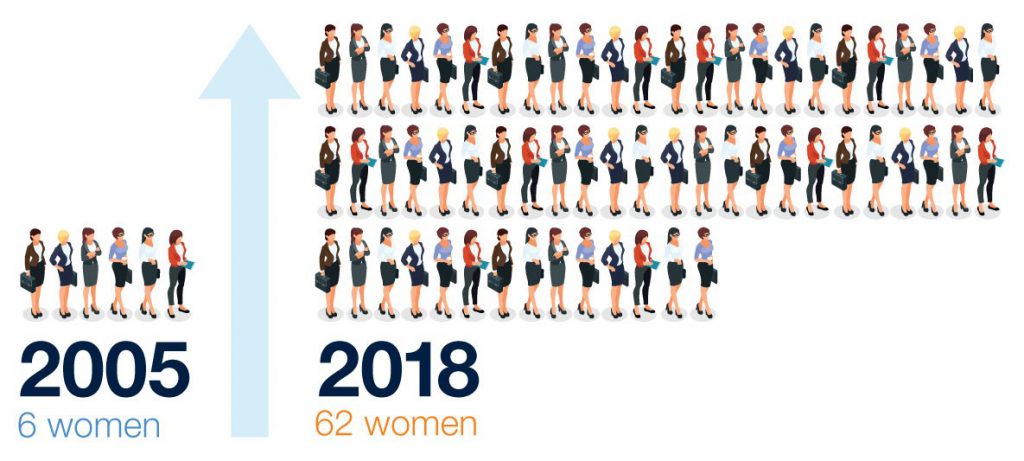
After our 2016 event, I wrote a piece (full article below) about the (albeit slowly) changing face of conference demographics…at that time, the percentage of women in attendance had grown from less than 1% in 2005 to around 5% in 2016…and as I write this today, I’m in the wake of a 2018 event which had a little over 10% female delegates.

Growth of numbers of women attending 12d events - 2005 vs 2018
Growth of numbers of women attending 12d events – 2005 vs 2018

Now, I won’t pretend I didn’t think about this in the lead-up to the event…I can’t say I didn’t wonder, at least in passing, whether we should be doing more to increase the numbers of women in attendance. Whether we should be offering incentives, creating more ‘content for women’…what’s the answer? Being a woman myself gives me exactly none of these answers.

As the Technical Forum drew nearer, I realised we’d actually been doing a bit of this organically, and I hadn’t really paid attention. In the line-up of presentations, we had more than one woman who’d put her hand up to speak to our eager audiences about a field of expertise. We’d even gone and booked a female guest speaker to try to fill the enormous shoes of Brian Shul, Dr Karl, and Dr Alan Duffy (incidentally, Dr Catherine Ball, the “Dame of Drones”, stepped up to this task with aplomb). At least two of our stand-holders in the exhibition space were women (which only sounds significant when compared with zero, even in 2016). And as things drew even nearer, I discovered that one of the top prizes in our Innovation Awards had been won by a woman, too (congratulations again to Megan Dillon of Mackay Regional Council for her ‘Banishing the Drafting Demon’ win!)…not because anyone felt that this should be the case, but because her entry was so spectacular that the judges just knew it was the one. To my mind at the time, adding too much to this organic gender equality gap-bridging would have felt disingenuous.

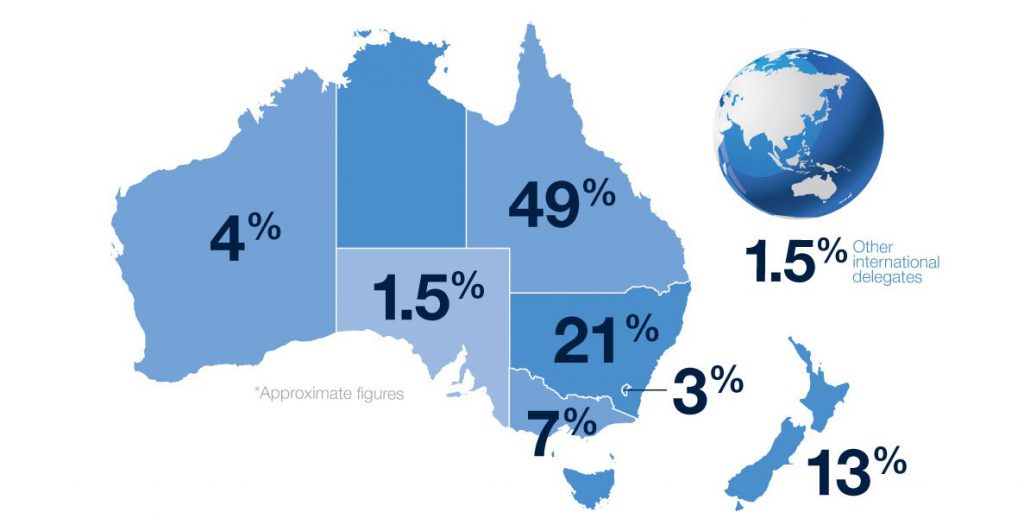
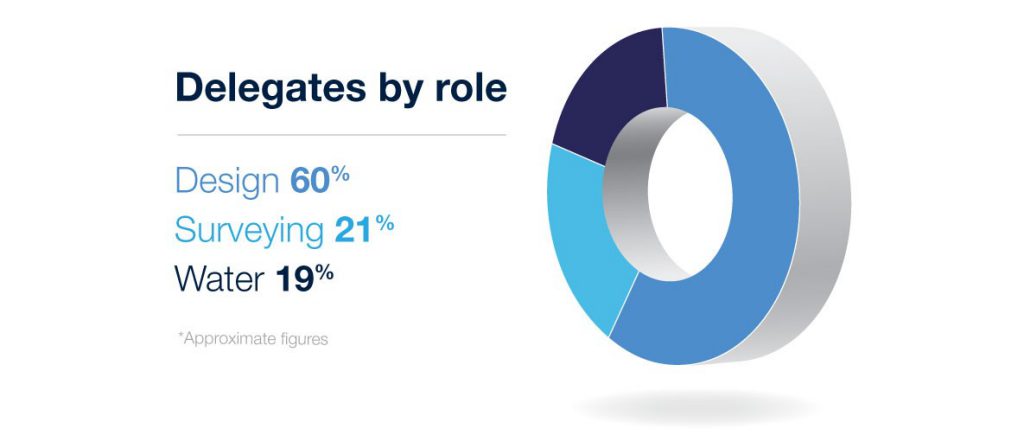
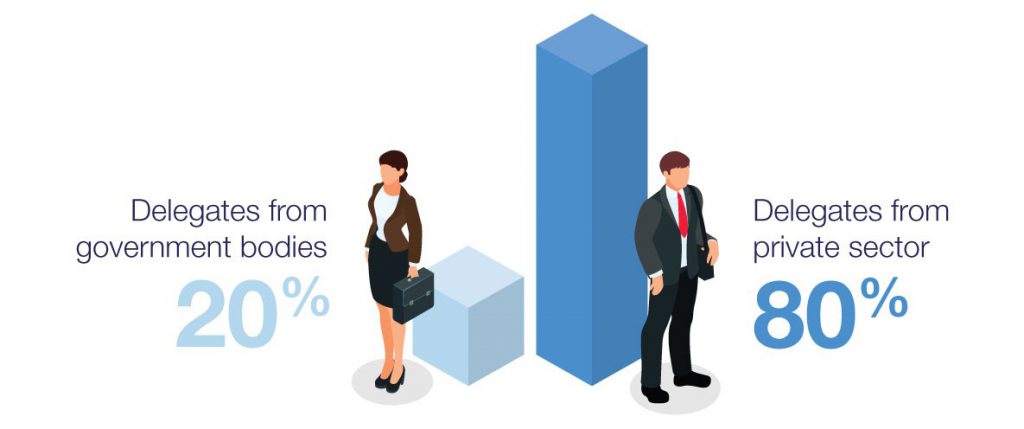
In any case, I don’t want to make this a blog entirely about gender (in)equality…there are other interesting demographics from the event I’ve been asked by delegates to share when possible!

Breakdown of regions - 12d Technical Forum 2018
Breakdown of regions – 12d Technical Forum 2018
Breakdown of role types - 12d Technical Forum 2018 delegates
Breakdown of role types – 12d Technical Forum 2018 delegates
Government vs Private Sector delegates - 12d Technical Forum 2018
Government vs Private Sector delegates – 12d Technical Forum 2018

This information is not only interesting, it will be useful for us in planning the many amazing information sessions that will form our 2020 Technical Forum…stay tuned for more details very soon!

–Lisa Stewart


2016 Piece – ‘Observations of Changing Conference Demographics’

Something came to light at our 2016 12d International Conference…we had more women in attendance than ever before. We’ve been holding these Conferences since 2005, and the numbers have been steadily creeping up over that time. We’re not talking life-changing numbers here, by any stretch – we’re still looking at perhaps 5% of delegates being female…but that’s crept up from 1% in 2005, so there’s a definite trend there. It’s noticeable not just anecdotally but statistically, and it was suggested to me that we highlight this somehow. But how?

It’s not that I’m not on board with celebrating bridging a gender gap in industries which really have no reason to be so male-dominated in this day and age. I’m not saying I don’t think it’s great that we’re slowly changing the world and not drawing arbitrary lines down who can participate in which activities. I’m just not sure how to best highlight how great this is without being patronising (I’m not convinced that being a woman myself would lessen the effect of this potential patronisation). Without subjecting these women to something I imagine they deal with almost daily…this concept of ‘othering’. Those moments that they’re reminded that they’re first women, and then engineers (or surveyors, etc.). When will we reach a point when everyone can just be a person with a job instead of a Female Engineer (“Isn’t that interesting?” “How great that a woman can do that!”)? Because why shouldn’t she be able to perform this job, or any, really?

Then again, if we pay no attention to this growing trend, we run the risk of not noticing that we’re progressing – albeit slowly – as a society. These are the indicators of this progress, and we can’t ignore them. But I think we need to just somehow point them out casually and move on, rather than making them a huge focus.

Survey Utility Modelling in 12d Model 14


Modelling and attributing services in 12d Model 14…made easy with the addition of new options!

I caught up with 12d Queensland’s Paul Hardwick this week to chat about Survey Utility Modelling as part of our ever-popular Training Webinar Series.

This webinar teaches you how to automate service modelling using tools such as:

  • Mapfiles
  • Attribute Manipulator
  • Service Chamber Many (new to 12d Model 14)
  • Global Attributes (new to 12d Model 14) – create your own customised list of Attributes!
  • Translate points by attribute depth (new to 12d Model 14)
  • Attribute depth validation (new to 12d Model 14)


Paul also talked us through such options as setting wall thickness and floor thickness, Global Close, and Create/Edit Attribute Manipulator File.

As we gear up for the 12d Model 14 release, such exciting ‘sneak peeks’ as this are really where it’s at for us!

The Technical Preview Version of 12d Model 14 is already in use exclusively by many of our customers on Maintenance who attended this year’s 12d Technical Forum…stay tuned for details of our 2020 event if you want to get in the loop early for 12d Model 15 as these lucky folks have done this time around!

Click here for training in your region: TRAINING DETAILS

–Lisa Stewart