
When the deadline is the Olympic Games, there is little room for redesign, delay or coordination issues.
When London was selected to host the 2012 Olympic Games, the city had to deliver large-scale venues and infrastructure capable of supporting approximately 24,000 athletes. The Olympic Village site presented an additional challenge: it was located within an already developed urban environment, constrained by surrounding infrastructure including a high-speed rail link, while also requiring new roads, earthworks and utilities to support the Games.
For Arup, the scale and complexity of the project called for a different approach to civil design. Stakeholder feedback meant that design options would continue to evolve, while contractors were already working to demanding construction programmes. Changes therefore needed to be assessed quickly and translated into construction documentation without disrupting the wider design.
Arup implemented 12d Model to bring the civil design together in a single, connected model. Earthworks, roads and utilities were modelled within 12d Model, allowing designers working on different elements to reference shared design information and coordinate their work.
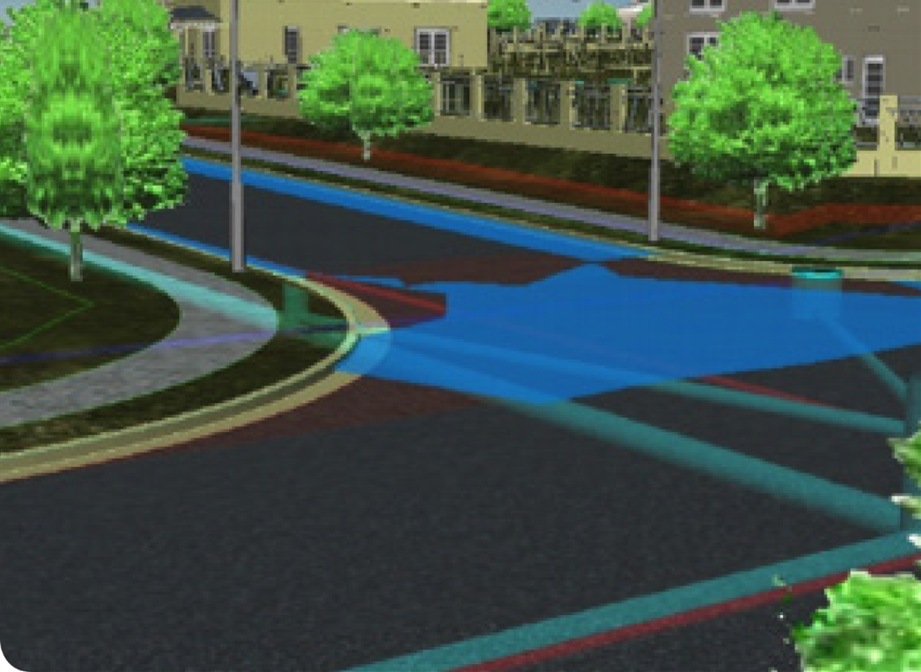
This was particularly valuable for the site’s extensive subsurface utilities. By modelling the utilities alongside the other civil elements, the team could identify potential clashes during design rather than discovering them during construction. As the design developed, 12d Model’s automated recalculation capabilities also allowed options and changes to be tested quickly, making it easier to assess their impact across the wider site.
The complete 3D model provided another important advantage. Arup and the client could review the civil design from all angles before documentation and construction, helping them assess how roads, earthworks and underground services would work together within the constrained site.
Once the design was confirmed, the model could be used to produce the documentation required by construction contractors. Automated processes and reusable standard components helped reduce manual work and accelerate the design cycle, supporting the project’s demanding programme.
The result was a more connected design process that allowed Arup to develop, coordinate, review and document the civil works within a single model, helping keep pace with one of the world’s most time-critical infrastructure projects.
As the project team noted:
“The modelling of all subsurface utilities in 12d Model was the ultimate design solution to prevent problems during the construction phase.”
The London 2012 Olympic Village is a strong example of how integrated civil modelling can help engineering teams manage complex sites, respond to changing requirements and make critical design decisions before they reach construction.
Download this Case Study as a PDF HERE