
Parsons Brinckerhoff (now WSP) delivered this project for the Queensland Department of Transport and Main Roads (TMR) in Brisbane, Queensland, Australia. It was completed in 2014.
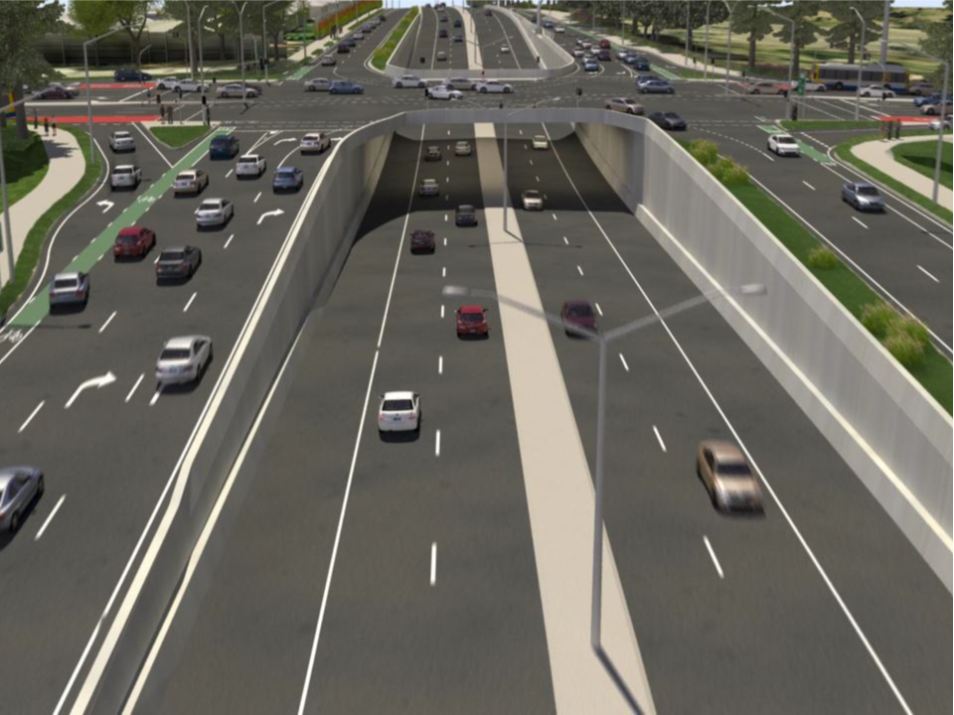
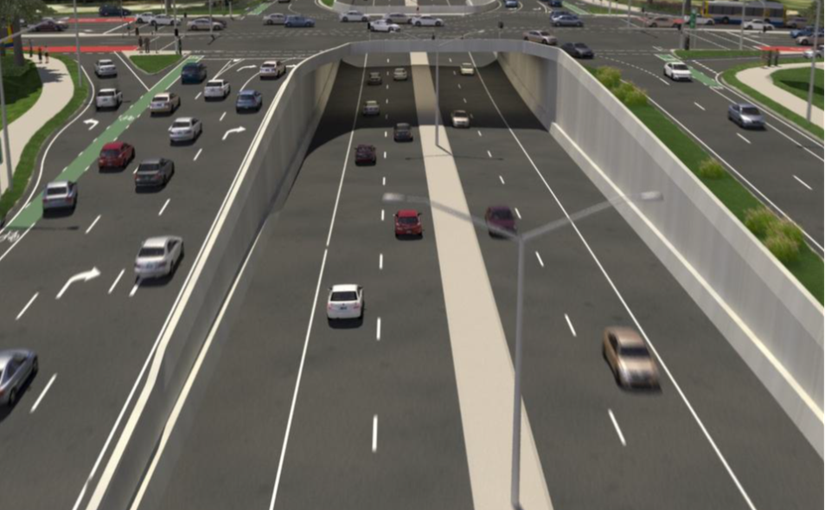
The intersection of Mains and Kessels Roads sits on the Brisbane Urban Corridor and carries about 90,000 vehicles a day. TMR wanted more capacity and a Mains Road upgraded for public transport. The proposal was a trough structure taking Kessels Road under Mains Road, plus an upgrade of about 2 km of Kessels Road and its intersections. Kessels Road would stay at six lanes but gain cycle lanes, with as little land resumption and as few service corridors as possible.
The challenge: services in a live, constrained corridor
Kessels Road is tightly bounded by commercial and residential properties. Many property accesses had to stay open while new public utility plant (PUP) was installed. The design team had to coordinate several disciplines at once: permanent road design, construction staging, existing underground services, new services and structural foundations.
The proposed services included:
- drainage networks with pipes up to 1350 mm in diameter
- Energex (underground and overhead)
- Telstra, ITS and lighting
- sewer, water and gas
On top of these came gantries, variable speed limit signs and more than 400 cast-in-place piles forming the trough structure. Piles and footings are often left out of design models because entering them is labour-intensive, so clashes are usually checked in 2D. This site was too constrained for that.
The solution: modelling every service in 3D
The team started from a 12da survey of the existing PUP and combined it with the permanent and staging road designs from the 12d projects. Each new service was modelled with the tool that suited it best:
| Service | 12d Model method |
|---|---|
| Energex, Telstra, ITS pits and conduits | Super Alignments + Apply Manys |
| Gas mains | Super Alignments + Apply Manys |
| Water mains | Super Alignments + Super Strings |
| Drainage and sewer pits and pipes | Drainage Network Editor |
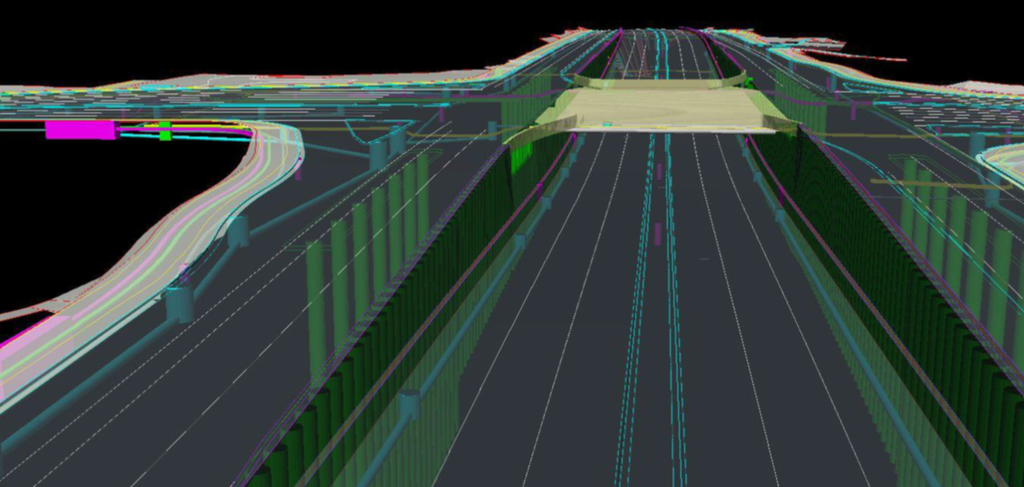
The service super alignments used computators linked to the road design and TINs, and were run in chains. When the road design changed, the services updated with it. Clashes with existing surveyed services showed up early, so the team could adjust alignments or modify structures before the design was fixed.
Piles and footings with the Spatial Information toolbar
To bring in the 400+ piles without manual entry, the team repurposed the Spatial Information toolbar. Mike Jenson had originally written its macros to place railway infrastructure along rail lines. The workflow had three steps:
- Create blocks. Standard 12d blocks for piles and footings of different depths and diameters were made with Product Create.
- Generate coordinates. Pile and footing locations were draped onto the surface, lowered 10 mm so the blocks wouldn’t stick out of the ground, and output as XYZ.
- Place blocks. The coordinates went into a pre-formatted table that Product Place Reader used to place each block in position.
Most of this was automated with chains. When the CSV files were updated and read back in, block locations updated automatically.
The result
The Spatial Information toolbar brought a large amount of structural information into the design model before full 3D structural modelling had started. As a result, clashes between services and footings were found early in the design phase.
The team also used the IFC writer to export the drainage, sewer and water pipe strings, the 3D road design, and the Energex, Telstra and ITS designs for viewing in MicroStation. Combining these models into a 3D PDF meant people outside the design team could see what the 12d designers saw on screen.
Key takeaway
Full 3D clash checking is usually held back by how long it takes to model piles, footings and services. This project shows that by linking super alignments to the road design and placing structural elements in bulk with blocks, 12d Model can deliver a coordinated, change-ready 3D model early in design, when fixing clashes costs least.