History Files: Engineering the Auxiliary Spillway at Warragamba – SMEC

In collaboration with the Sydney Catchment Authority, SMEC harnessed the capabilities of 4D Model (now 12d Model) to design and deliver key components of the Warragamba Dam Auxiliary Spillway project, enhancing design accuracy, visualisation, and earthworks management for a major infrastructure upgrade.

The major source of Sydney’s water supply is Warragamba Dam. Australia’s fourth largest dam, its primary function is to provide a water supply for the Sydney Metropolitan area. When adequate quantities of water are stored to meet these needs, electricity is generated and fed into the NSW grid by the hydro-electric power station located at the base of the dam.

Warragamba Dam is in the High Incremental Flood Hazard category and to prevent overtopping of the dam in extreme flood events, an auxiliary spillway is being constructed adjacent to the dam to divert floodwaters in excess of the capacity of the existing spillway.

The auxiliary spillway is a major civil engineering project due for completion in mid-2001. The works are being undertaken on a design and construct basis for the Sydney Catchment Authority (previously known as the Sydney Water Corporation) to improve the safety of the dam. In December 1998, the contract for the design and engineering of the spillway was awarded to SMEC, the Snowy Mountains Engineering Corporation.

The project involves major excavation – some 1.8 million cubic metres of sandstone and overburden is being removed and transported to a spoil emplacement – and the concrete lining of the auxiliary chute spillway which will be approximately 650 metres long and drop 50 metres before discharging to the river.

Five fuse plugs – embankments that are designed to wash away when overtopped – are being built at the upstream end of the spillway chute to prevent the auxiliary spillway from operating in flood flows smaller than about a one in 750 chance of occurrence in any year.

Generally, the floor and wall of the spillway chute are in the form of a reinforced concrete lining against the excavated rock surface, however, one section of the spillway over an existing creek line will be constructed on compacted fill with cantilever walls on either sides. A bridge across the spillway, and a new road, are designed to provide access to the crest of the dam, the Valve House and the hydro-electric power station at the base of the dam.

Following concept design carried out by the Department of Public Works and Services, SMEC is responsible for the development of the detailed design – from concept to production of construction drawings. A vital component in SMEC’s engineering design work is 4D Model (later renamed 12d Model) software. Design draftsman on the project, Michael Kurtz, says it contains all the options necessary to produce a digital terrain model (DTM), including fast triangulation, contouring and sectioning routines, and to calculate spill volumes for accurate placement and subsequent costing of the work carried out.

Warragamba Project Manager, John Gray, said 4D Model software was primarily used for design and modelling of the auxiliary spillway and associated access structures such as roads and the bridge approach, along with calculation of spill volumes.

“Using 4D allows us to continually modify designs,” Michael said, “and, most importantly, to do it quickly. 4D allowed us to complete re-designed versions very fast for presentation to the client and to show the designs interactively in plan and sectional views. We also had to continually modify the design to fit the spoil emplacement within specified confines nominated by the client. The spoil would not fit into the area initially defined and required many modifications of the design.

“The perspectives we can provide using 4D are an easy way to convey a design to people who find engineering plans and contours difficult to interpret,” Michael said. SMEC uses the 4D alignment module to construct strings consisting of horizontal and vertical geometry. These horizontal and vertical components are created and edited interactively using the IP method on plan and section views.

SMEC is also using the 4D Drainage Module in the Warragamba project. This module supports the display of drainage networks typically required for development projects and new land subdivisions. An added bonus SMEC encountered using 4D was the ease with which the model output could be checked at any stage of the design process.

Following development of a design component, a copy of the model was produced for checking and further development by design engineer, Tim Loffler. Tim, who had no previous training in the software, said he found it “a most intuitive package” and that he could view and interrogate the model after getting a feel for the way in which the program operates.

“The program is very robust and will faithfully do what you ask it to do,” he said.

Download this Case Study as a PDF HERE.

History Files: Waterman floods the UK – Waterman Civil & Transportation Group

In collaboration with the Environment Agency in the United Kingdom, Waterman Group utilised 12d Model to undertake a detailed flood risk assessment for a major 3,000-home development, streamlining complex data workflows, enhancing analysis precision, and supporting effective planning outcomes.

Waterman Civil & Transportation Group (WCT) was one of the original 12d Model software users in the UK and have finalised an initial study for a housing development of 3000 homes at Waterlooville on the South Coast of England.

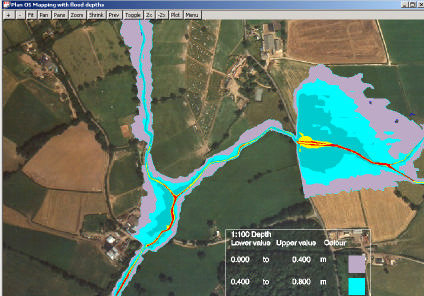
This study involved a detailed assessment of flood risk in the area. The Environment Agency had done rough flood outlines based on a 50m grid using the Flood Studies Report, but a detailed assessment was required for planning to determine the existing flood plain and to compare this with another ‘post development’ flood study.

For cost and speed, aerial photogrammetery was ordered to cover the entire site and local surveyors were used to locate the property boundary using traditional means. The resultant photogrammetery (dgn format) and boundary (dxf format) were merged into a single 12d digital terrain model of several hundred thousand points.

To obtain finer detail of the river and to verify the model of the plain, further detailed river cross sections were then surveyed. In the office, work began on building the HEC RAS project inside 12d Model.

After ensuring concurrence on hydrological methodologies with the local Environment Agency office, WCT carried out the back water hydraulic study. Graduate Engineer and 12d user Richard Russell said, “Using 12d with HEC RAS I was able to devote more time to sensitivity tests in HEC RAS and in 12d. I had the luxury of time to try different roughness coefficients and to test if ground cover picked up with the photogrammetery had a significant impact on the results. This gave us better confidence in the final results”.

In addition to creating the HEC RAS project, 12d Model was used to present the water level results. Detailed drawings were produced for submission to the Environment Agency. Internally the visualisation abilities in 12d allowed quick checking at all stages including the final water levels.

Project Director for WCT, Stuart Aldridge, commented, “12d cut the time taken for this type of study significantly. This was the first time we had used 12d for flood modelling and we were very impressed.

“Previously, significant resources were devoted to what I now view as laborious and unnecessary data entry. We also get to use survey data at a much earlier stage, which is proving useful on such a big development. We still propose a detailed survey for a later date, but for now our client can defer the significant cost of the survey until much later.”

While WCT and their client were benefiting from using 12d Model on this project, the two other parties involved also had the opportunity to see 12d in action on a live project. Although both have different interests and uses for 12d, surveyors Julian Brotherton & Partners and the Environment Agency were both impressed with 12d’s quick manipulation of data and 3d abilities. Within a few months both parties became 12d users themselves.

Download this Case Study as a PDF HERE.
History Files: Victorian Major Projects – WSP | Parsons Brinckerhoff

WSP in Victoria, Australia (https://www.wsp.com/en-AU) has been involved in a number of infrastructure projects, working alongside various clients and contractors, including David Rotton, to deliver coordinated engineering solutions.

Parsons Brinckerhoff has been involved in a number of large-scale, high-profile projects covering the design of roads, drainage, sewer, water, and other associated infrastructure, as well as bulk earthwork modelling. Their project teams used 12d Model software to address a range of complex and non-standard challenges, often requiring innovative and customised solutions. Given the scale and nature of these projects, they also needed to collaborate closely with multiple consulting engineering companies, which meant their chosen software had to interact seamlessly with different design platforms used across project teams.

A key requirement was the ability to check clearance and identify potential clashes between services designed in 12d Model and those produced in other software packages. However, limitations in compatibility between import and export formats across platforms meant that alternative methods had to be developed to enable reliable data exchange between systems. This was particularly important for transferring three-dimensional pipeline data elements across drainage, sewer, water, and related services. In addition, the team explored new applications of 12d Model by successfully modelling complex electrical and chemical box culvert systems, which had not previously been attempted.

To address these challenges, detailed working procedures were developed, including step-by-step guides to support consistent data transfer across project teams. These processes enabled 12d Model to export data in .csv format in a structure that could be read by other software, as well as import .csv data generated externally back into the model environment. A custom macro was created to extract three-dimensional pipe data from 12d Model and export it into .csv files for use in other platforms. Electrical and chemical box culverts were modelled using an adapted approach based on drainage strings, with the Drainage Network Editor used to define culvert height and width. The Drainage Plan Plot function, supported by a modified plot parameter file, was then used to represent the culverts with accurate internal geometry, enabling effective service clash detection directly within 12d Model.

Through the use of 12d Model software and these tailored workflows, the team was able to overcome a range of complex and non-standard design challenges across very large projects. This approach also supported effective collaboration with multiple consulting engineering companies, ensuring smooth interaction between 12d Model and the various design software platforms used across project stakeholders.

Download this Case Study as a PDF HERE

12d Tech Forum 2026

The 12d Tech Forum offers a fantastic opportunity for engaging in educational sessions, fostering valuable connections, and networking (sometimes over dinner and drinks!) with other members of the 12d community. 

The 12d Tech Forum is the top destination for 12d Model and 12d Synergy customers and partners to gain knowledge and become a part of a thriving community of industry leaders and enthusiasts. It’s where the infrastructure industry’s finest minds come to learn and share, and it aims to fuel creativity, offer practical expertise, and connect. 

The 12d Tech Forum 2026 will highlight 12d Model 15 C1u, which will be released before the 12d Tech Forum so you can use all the new features straightaway. The event will also feature exciting updates about 12d Synergy 6. 

When and where  

Dates: Sunday 26th, Monday 27th, and Tuesday 28th July 2026 
Venue: Brisbane Convention and Exhibition Centre (BCEC) – Plaza Level 

Cost 

The Full Tech Forum Package for $1,350 +GST  includes: 

• Welcome Event for one person 
• Tech Forum Gala Dinner *for one person 
• 3 Full Days of Tech Forum Main Sessions 
• Any ‘Birds of a Feather’ Sessions 
• Award-winning food at all Morning/Afternoon Tea Breaks and Lunches 
• 12d Polo Shirt and Other Goodies! 
*Includes the 12d International Innovation Awards 2026 Ceremony 

Credit card payments are accepted through our online store. Day passes are also available through the 12d Tech Forum website

What to expect 

At this three-day event, 12d Solutions will be highlighting exciting features in 12d Model including new sub-versions, as well as new developments in 12d Synergy, and more! We will continue the ever-popular ‘Birds of a Feather’ breakout sessions on Design, Surveying, 12d Water, and Information Management…PLUS a new Special Interest room which will include sessions on 12d Model Macros, and a variety of other speciality topics from 12d Model and 12d Synergy. 

This event will be an invaluable learning and networking experience for users of 12d products and other industry professionals, in all areas of civil design, surveying and construction, water engineering, data management, and project collaboration. This event is suitable for users of all levels of expertise. 

We’ll also have an expanded Exhibition space this time, since we’re in a bigger area—this will feature stands from suppliers such as: 

·  Abtrac
·  Civillo 
· C.R. Kennedy 
· Aptella
· 4D Prisma 
· Digital Enginuiti 
· ManGoes Mapping 
· CHCNav 

Brought to you by our Sponsors: 

Gold sponsor

Silver Sponsors

Bronze Sponsors

This image has an empty alt attribute; its file name is Surveyors-Australia-logo-original-1024x480.jpg

Coffee Cart Sponsor

Gala Dinner Sponsor

The 12d Tech Forum offers: 

• A great opportunity to increase your 12d Model/12d Synergy skills 
• The ability to interact with the developers of 12d products 
• The chance to network with, and learn from, other 12d users. 

Reasons to attend the 12d Tech Forum 2026 

#1 Gain Invaluable Education and Training 

Whether you’re a tech newbie or a super user, the 12d Tech Forum is the perfect place to equip your team with invaluable tips and tricks that will boost efficiency and productivity. Discover the latest software updates, industry trends, and best practices to help your team stay ahead of the curve. 

#2 Expand Your Network  

The 12d Tech Forum isn’t just about education and training – it’s also a fantastic opportunity to connect with other professionals in your field. Rub shoulders with industry peers, make valuable connections, and exchange ideas that could take your career or business to the next level. 

#3 Get Inspired by Industry Leaders 

Elevate your knowledge and gain valuable insights from the 12d Model and 12d Synergy leaders themselves. Learn about the latest technological trends and advancements that will shape the future of the industry. Discover innovative solutions and strategies to help you take your business to the next level. 

#4 Unleash Your Potential  

The 12d Tech Forum offers a unique opportunity for personal and professional growth, with access to the latest industry trends, practices, and innovations. Expand your knowledge and network with like-minded individuals who share your passion for technology. 

#5 Join the 12d Community and Thrive Together 

The 12d Tech Forum is more than just an event, it’s a chance to join a thriving community. Connect with the 12d Model and 12d Synergy teams, including executives, to share your knowledge and gain valuable insights from experts in the field. Make lifelong friends and be a part of a community that has been growing and thriving for over 30 years.  

#6 Celebrate the Industry’s Achievements and Have Fun! 

Our Innovation Awards Ceremony is the highlight of the event. Attend the Tech Forum Gala Dinner to applaud the ground-breaking work and extraordinary achievements of the global 12d Community. 

Registrations have been rolling in; let’s get excited together…register today! 

12d Model’s 2D Water Analysis Tools

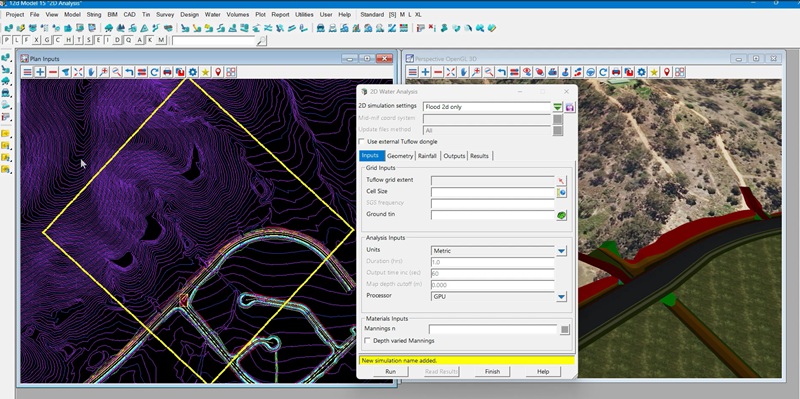
Building on the user-friendly GUI of 12d Model’s 2D Quick Analysis, the 2D Water Analysis tool extends the features and commands available for 2D modelling in 12d Model.

Dylan Revell of 12d NZ takes you through this functionality to demonstrate how it can work for you!

You can watch the video here:

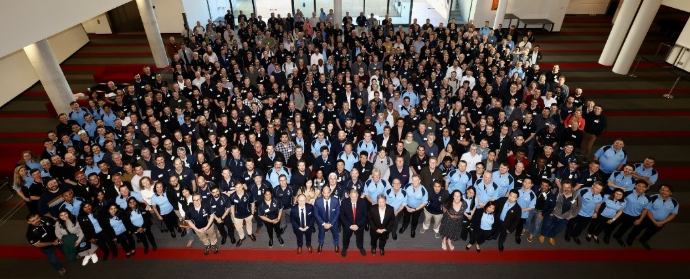
The sold-out 12d Tech Forum 2024 was a raging success, and we were thrilled to see so many of you there in person! There was only one problem from our perspective, and that was a pretty good one really – we had more content than we could showcase in three days! So we’ll be running these webinars until that excess material is exhausted – a “Director’s Cut”, if you will!